Wondering how much you can earn renting your Davenport home on Airbnb? You’re asking the right question — and the answer depends on more than just location.
A well-managed Davenport vacation rental can earn anywhere from $35,000 to $80,000+ per year, depending on your property’s size, location, amenities, and how it’s managed. That range is wide for a reason. The difference between an average Davenport Airbnb and a top-performing one isn’t luck — it’s strategy.
This guide breaks down what Davenport hosts are actually earning in 2026, what drives the variance in income, which months generate the most revenue, and what you can do to push your property toward the upper end of the range.
What the Market Data Says: Davenport Airbnb Income in 2026
Davenport is one of the strongest short-term rental markets in Florida — and the numbers back that up.
Based on 2026 data covering April 2025 through March 2026, Davenport hosts earn approximately $31,874 per year on average, with a nightly rate of $278 and a RevPAR of $113. That’s the market average — but average performance reflects a wide mix of properties, including those with poor photos, static pricing, and limited amenities.
Here’s what the data shows across performance tiers:
| Performance Level | Annual Revenue | Monthly Revenue | Occupancy |
|---|---|---|---|
| Top 10% | $93,000+ | $7,750+ | 84%+ |
| Top 25% | $63,600+ | $5,300+ | 69%+ |
| Median | $38,500 | ~$3,200 | ~46% |
| Bottom 25% | Under $21,000 | Under $1,750 | ~24% |
Source: AirROI 2026 market data, Davenport, FL
The takeaway isn’t just what the numbers are — it’s why the gap is so wide. Properties in the top tier share a predictable set of characteristics: private pools, game rooms, themed bedrooms, resort community access, dynamic pricing, and professional management. Those aren’t accidents. They’re the result of deliberate decisions.
For larger homes specifically, many 4–6 bedroom pool homes near Disney in Davenport average ADRs in the $260–$325 range with 60–70% occupancy — and with strong reviews and a seasonal strategy, total annual revenue can reach $60,000–$80,000+.
What Makes Davenport Such a Strong Market?
Davenport isn’t a random vacation rental market. It’s one of the most structurally favorable short-term rental environments in the country, for reasons that go beyond just being close to Disney.
Location Without the Premium Price Tag
Davenport sits in Polk County, just southwest of Orlando — close enough to Walt Disney World (typically 10–20 minutes), Universal Studios (20–25 minutes), and Universal Epic Universe to justify a full family vacation, but far enough from the tourist corridor that property prices are meaningfully lower than in Kissimmee or Orlando proper. That combination — strong tourism demand, competitive acquisition costs, and large resort-style homes — creates favorable math for investors and homeowners alike.
Epic Universe Changed the Demand Equation
The opening of Universal Epic Universe in May 2025 significantly expanded Central Florida’s tourism draw. Universal Orlando president Karen Irwin described it as transforming the resort “into more than a full week’s vacation destination,” with Universal sales among travel agencies up approximately 30% year over year after opening.
Hotels and vacation homes across the Kissimmee and Davenport area saw measurable booking increases immediately — one Kissimmee-area property reported a 14% occupancy increase in the weeks following the opening. Davenport properties, positioned near the I-4 corridor with easy access to both Universal and Disney, are direct beneficiaries of this demand shift. Families are now planning longer Orlando trips to cover both parks, creating stronger demand for large vacation homes where groups can stay for a week or more.
A Regulation-Friendly Environment
Compared to many Florida markets where local governments have restricted short-term rentals, Davenport operates under a relatively straightforward regulatory framework. There’s no city-wide ban on STRs, no cap on rental nights, and the licensing process — while required — is manageable. Our guide on Is Airbnb Legal in Davenport, FL? walks through everything you need to know, including DBPR licensing, Business Tax Receipt requirements, and HOA considerations.
Seasonality: When Does Davenport Peak — and When Does It Slow?
Understanding Davenport’s seasonal rhythm is essential to setting realistic income expectations and planning your pricing strategy.
Davenport sees its highest demand in summer, with July being the strongest month. The slowest period is September. During peak months, revenue can climb to $4,600 with occupancy reaching 60.6% and ADRs peaking at $318. During the slowest month, revenue may dip to around $2,829 with occupancy around 35% and ADRs adjusting to approximately $231.
Peak season (high demand, high rates):
- Summer school holidays (June–August) — families with children dominate this window
- Spring Break (March–April) — one of the highest-occupancy periods of the year
- Thanksgiving week and Christmas/New Year — strong demand, premium pricing opportunities
- Long weekends: Memorial Day and Labor Day
Shoulder season (moderate demand, strategic pricing matters):
- May and early June — demand builds toward summer
- October and early November — pleasant weather, fall break travelers
- Late January through February — snowbirds and winter visitors
Slower period:
- September through mid-October — lowest demand window; focus on longer minimum stays, direct bookings, and competitive pricing to maintain occupancy
One notable shift: the opening of Epic Universe has started to strengthen spring and early summer bookings, since many families are now planning dedicated Universal trips that didn’t exist before May 2025. Expect this shoulder-season softness to continue reducing over the next 12–24 months.
What Drives the Difference Between Average and Top-Earning Properties?
Market averages can be misleading. An average reflects every property in a market — including those that are under-photographed, inconsistently priced, and poorly maintained. Here’s what actually separates top earners from the middle of the pack in Davenport.
1. Property Size and Configuration
Davenport is a large-group destination. Families traveling to Disney or Epic Universe often have 6–12 people across multiple generations. A 4-bedroom home comfortably serves that group; a 6–8 bedroom home captures larger groups willing to pay significantly more per night because the alternative is booking two hotel rooms at $300+ each. A well-run 6-bedroom pool home in a resort community typically outperforms a standard 3-bedroom property by 2x in annual revenue.
2. Private Pool (Non-Negotiable in This Market)
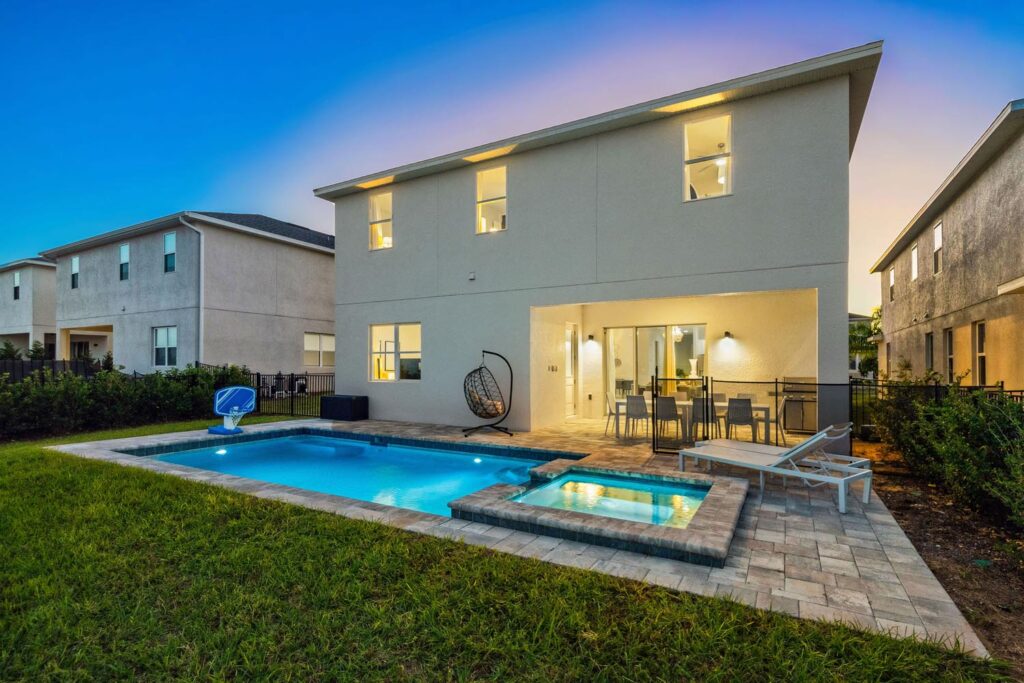
In Davenport, a private pool isn’t a luxury amenity — it’s a booking filter. The vast majority of guests specifically search for pool homes. Properties without a pool are competing in a fundamentally smaller demand pool. A heated private pool can increase annual revenue by $8,000–$15,000 depending on property size and location. Properties offering optional pool heat generate additional revenue per stay during winter months.
3. Resort Community Access
Davenport’s premier resort communities — ChampionsGate, Solterra, Windsor at Westside, and others — offer amenities that standalone homes can’t replicate: lazy rivers, waterslides, clubhouses, and fitness centers. These communities consistently command higher ADRs and occupancy rates because guests get two experiences in one: a private home plus resort-style amenities.
4. Dynamic Pricing vs. Static Rates
One of the most common revenue leaks for self-managing owners is static pricing — setting a flat nightly rate and leaving it. This means undercharging during high-demand weeks like Spring Break and overcharging during slow periods, resulting in empty nights. Professional property management companies use dynamic pricing tools that adjust rates daily based on market demand, competitor availability, local events, and seasonal patterns. The difference between static and dynamic pricing in Davenport can represent $5,000–$12,000 in annual revenue for a mid-size property.
5. Listing Quality and Platform Optimization
Davenport has thousands of active vacation rental listings. A guest searching for a 5-bedroom pool home near Disney is looking at dozens of options — and making their decision based on photos, listing title, review score, and price within the first 30 seconds. Professional photography and an optimized description that speaks directly to your ideal guest consistently outperform listings that treat the description as an afterthought.
6. Review Score Maintenance
Airbnb and VRBO both use review scores as a ranking signal. Properties with a 4.8+ average consistently appear higher in search results. Guest experience — a clean home, working amenities, fast communication, and thoughtful touches — drives that score. It also drives repeat bookings and word-of-mouth referrals, which reduce your dependence on platform-driven traffic over time.
Understanding Your Tax Obligations in Davenport
Revenue projections need to account for tax obligations, which are a real cost of operating a short-term rental in Polk County.
The Tourist Development Tax rate in Polk County is 5%, collected from guests at the time rent is charged and remitted monthly to the Polk County Tax Collector’s Office. Florida’s state sales tax on transient rentals adds 6%, with a 1% Polk County discretionary surtax — bringing the combined tax burden to approximately 12%.
For Airbnb bookings, Airbnb collects and remits the 5% TDT on behalf of hosts for reservations of 182 nights or shorter. However, if you receive bookings through other platforms or directly, you are responsible for collecting and remitting this tax yourself.
Even if you use Airbnb exclusively, you are still required to register with Polk County. According to the Polk County Tax Collector’s official guidance, anyone renting short-term accommodations in Polk County for periods of six months or less must obtain a Class B County Local Business Tax Receipt for each rental location, regardless of which booking platform is used. A professional property management company handles this registration and filing as part of their service.
Self-Managing vs. Professional Management: What’s the Real Difference?
Many Davenport owners start by self-managing, and some do it well — especially if they live locally and have time to dedicate to it. But the picture changes significantly for owners who live out of state, manage multiple properties, or want genuinely passive income.
The case for professional management isn’t just convenience. It’s about optimizing pricing, marketing, guest experience, maintenance, and compliance simultaneously and consistently. Most self-managing owners underperform on at least one or two of those dimensions, and that gap shows up directly in annual revenue.
If you’re evaluating what professional management costs in the Davenport area, our detailed breakdown of how much Airbnb property management costs covers fee structures, what’s included, and how to evaluate whether it makes financial sense for your property.
A Realistic Income Example: 5-Bedroom Pool Home in Davenport
To make this concrete, here’s a realistic income model for a well-managed 5-bedroom pool home in a Davenport resort community:
| Metric | Estimate |
|---|---|
| Bedrooms | 5BR / 4BA |
| Pool | Private, heated |
| Community | Resort access included |
| Average Daily Rate | $285 |
| Annual Occupancy | 62% |
| Nights Booked per Year | ~226 |
| Gross Annual Revenue | ~$64,400 |
| Management Fee (20%) | ~$12,900 |
| Taxes (TDT + Sales Tax) | Collected from guests — not deducted from owner revenue |
| Cleaning / Maintenance (est.) | ~$8,000–$12,000 annually |
| Net Owner Revenue (est.) | ~$39,500–$43,500 |
This is a conservative-to-mid scenario. Properties in ChampionsGate or Solterra with premium amenities and strong reviews regularly exceed these figures. Properties that are professionally managed, dynamically priced, and well-photographed at this size are capable of generating $70,000–$80,000+ gross in strong years.
You can see how your specific home might perform using Blue Gems’ free income estimate — get a personalized projection based on current Davenport market data. Get your free Davenport income estimate →
Davenport vs. Other Disney-Area Markets
If you’re comparing Davenport to other nearby markets, it’s worth understanding the tradeoffs. Kissimmee properties tend to command slightly higher ADRs in certain resort communities given the density of theme park access, but Davenport offers better property acquisition value and more space per dollar. For a detailed side-by-side analysis, see our full guide: Kissimmee vs. Davenport for Airbnb Investment: Which Performs Better?
If you’re still researching whether Davenport is the right market, our Complete Guide to Airbnb Investment in Davenport, FL covers regulations, licensing, tax setup, and everything else you need before you list.
The Bottom Line
Davenport is one of the best short-term rental markets in Florida. The combination of Disney proximity, the addition of Epic Universe, a favorable regulatory environment, large family-friendly homes, and consistent year-round demand creates real income potential for property owners who approach it strategically.
The wide earnings range — from under $20,000 to over $80,000 annually — is not random. It reflects the difference between properties that are well-managed, well-priced, and well-presented, and those that aren’t. The market rewards execution.
If you want a realistic projection for your specific property — based on actual comparable data in the Davenport market — the Blue Gems team can provide a free income estimate with no obligation.